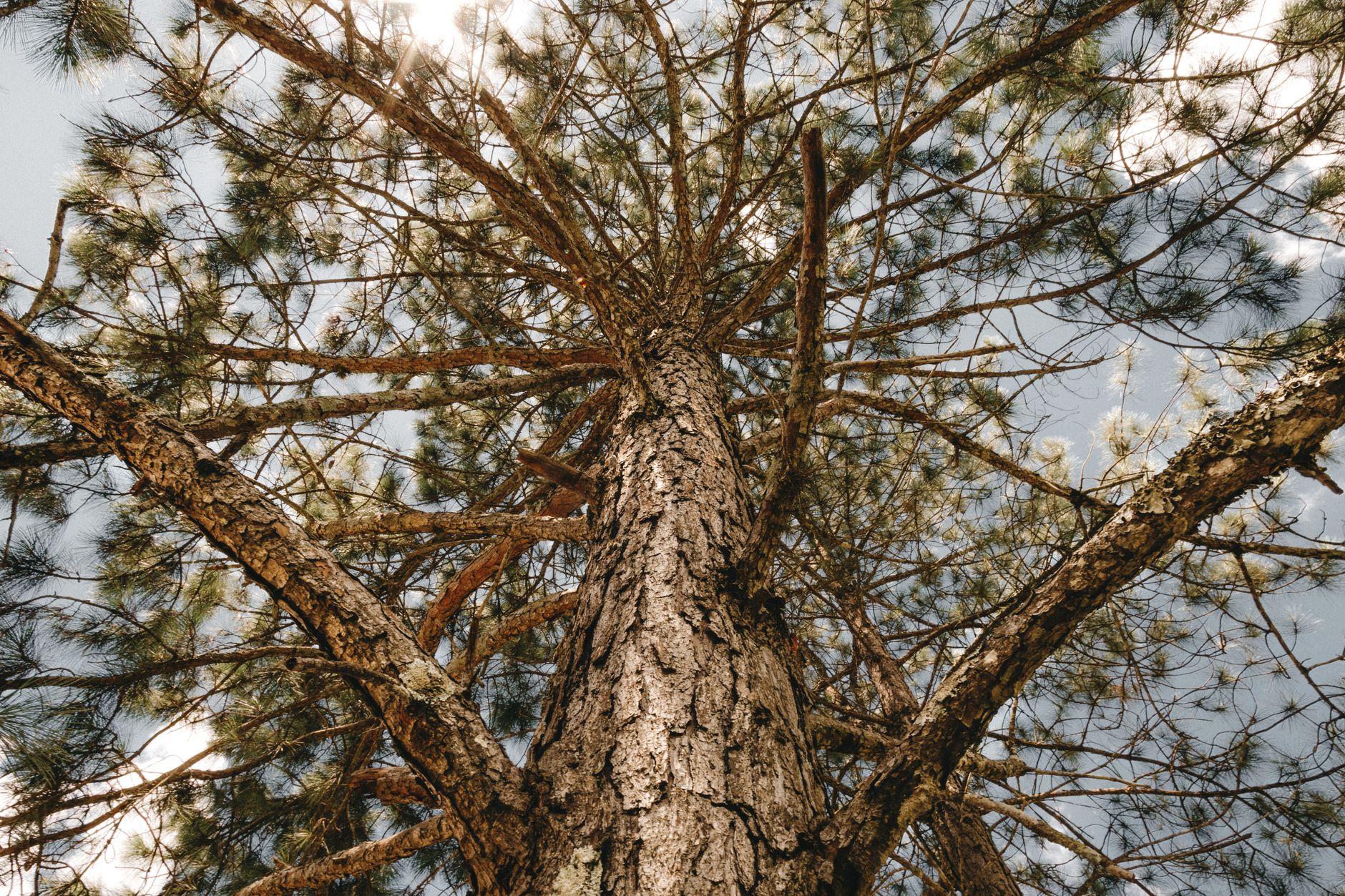
A Longview homeowner can prune dead limbs from a loblolly pine in any season, should remove a pine with a failing root plate or beetle damage soon, and should call an arborist before cutting anything near a roof or a power line. Pruning handles small, reachable problems on a healthy tree. Removal handles a tree that can no longer hold itself up. An arborist decides which one applies when the signs are mixed.
East Texas puts its own stress on tall pines. Gregg County sits in the Piney Woods, where loblolly and shortleaf pines grow fast in red clay that swells in wet months and cracks in dry ones. Summer drought, ice storms and straight line winds all test the same trees, so the right call depends on what the tree has already been through.
How can a Longview homeowner tell a loblolly pine is declining?
Needles that turn yellow or rusty brown in the middle of the crown tell a homeowner a loblolly pine is declining. A healthy pine holds green needles at the ends of its branches year round and drops only the oldest inner needles in autumn. When the whole top fades, when branches stay bare for a full growing season, or when the bark carries small round exit holes and pitch tubes the size of a pencil eraser, the tree is under attack from bark beetles or root rot. Pine bark beetles favor trees weakened by drought, so a pine that looked fine in spring can fail by the end of a hot August. Woodpecker activity on the trunk is another quiet clue, because birds go after the larvae under the bark. A homeowner can check these signs from the ground with binoculars and a walk around the base. Mushrooms near the roots, soft or crumbly wood at the base and a trunk that sounds hollow when tapped point to decay that no pruning will fix.
Which season suits pruning in Gregg County?
Late fall through winter suits pruning in Gregg County, because beetles that attack fresh pine cuts are least active when nights turn cool. Pine resin flows from every wound, and the smell of fresh sap draws engraver beetles during the warm months. Cutting dead or broken limbs between November and February gives the wounds time to seal before the insects return in spring. Hardwoods that grow beside the pines, such as water oak and sweetgum, tolerate pruning earlier in autumn. Dead wood can come out at any time, since a dead branch has no sap to attract anything. After a storm, broken limbs should come down quickly regardless of the calendar, because a hanging limb can drop without warning. A good rule is to remove no more than about a quarter of the live crown in one visit, and to leave the branch collar, the slightly swollen ring where a limb meets the trunk, intact so the tree can close the wound.
When does a pine need removal rather than pruning?
A pine needs removal rather than pruning when more than half of the crown is dead, when the trunk has a deep vertical crack, or when the roots have lifted the soil on one side. Those signs mean the structure is failing, and trimming the living branches only adds weight to a weak frame. A lean that appeared suddenly after a storm is more dangerous than a lean the tree has held for decades, because a fresh lean often means the roots have already torn. Look for a crescent of raised or cracked soil on the side opposite the lean. In Longview's clay soil, a saturated lawn after a week of rain makes that tear more likely, and a tree that stands over a house, a driveway or a fence line should be taken down before the next wet spell rather than after it. Dead pines also become brittle quickly. Standing dead wood sheds limbs in modest wind, so waiting a season to see what happens carries real risk for anything underneath.
What do East Texas storms do to tall pines?
East Texas storms snap tops, strip limbs and push shallow root plates out of soft ground. Loblolly pines grow tall with relatively narrow crowns, so wind loads concentrate high on the trunk. Ice storms add weight to every needle cluster, and the cold snap of February 2021 showed how many pines across the region lost large limbs under frozen buildup. Spring thunderstorms bring gusts that topple trees already weakened by a wet winter. After any storm, walk the property and look up. Hung up limbs, split trunks and branches resting on other branches should be left to a crew with ropes and rigging, because the load on a hanging limb is unpredictable and a homeowner on a ladder underneath is in the worst spot possible. Leave any tree touching a power line alone and call the utility, since only the utility can handle lines safely.
What happens to the stump and roots after removal?
A removed pine leaves a stump that can be ground below the soil line, left to decay or treated, and grinding is the most common choice for a yard that will be used again. A stump grinder chips the wood to a depth that depends on the next plan for the spot, deeper for a replacement tree and shallower for sod. Pine stumps rot slowly in East Texas, and the old root system can host fungi that spread to nearby living trees, so clearing it helps the surrounding landscape. Buried pipes, irrigation lines and cables sit near roots, so the area should be marked before any grinding starts. The chips can be raked into beds as mulch once they have aged, though fresh pine chips are best kept off vegetable gardens. Replanting in the same spot works better after a season of rest, and a different species such as bald cypress, live oak or a native oak suits a site where the previous pine died of disease.
How should a homeowner choose an arborist near Longview?
A homeowner should choose an arborist who can show proof of liability coverage and workers compensation, who inspects the tree before quoting, and who explains the plan in plain terms. Credentials from the International Society of Arboriculture, which certifies arborists, are a good sign, and the Texas A&M Forest Service publishes guidance on tree health that a reputable crew will know. Ask whether the plan keeps cuts small and avoids topping, the practice of chopping the crown flat, which leaves weak regrowth and stresses the tree. Ask who handles cleanup and whether the crew works near wires. A written scope that names which trees, which limbs and which cleanup steps are included prevents confusion on the day of the job.
A short seasonal habit helps every Longview property. Look up after each storm, check pines at the base each spring, and watch for fading tops at the end of summer. Small, early action on a healthy tree costs far less than an emergency removal after it lands on a roof.